

MOTORSPORTS SHOWS THE WAY: NORTH CAROLINA’S SPORTS ECONOMY IS AN ECONOMIC COMPETITIVENESS ASSET
North Carolina has always understood the cultural power of sports. The NC Chamber Foundation’s new report, North Carolina’s Sports Economy: From Cultural Identity to Competitiveness Asset, makes clear that sports should increasingly be understood as something more: an economic asset.
And nowhere is that case stronger than in motorsports.
The report examines everything from professional and college athletics to golf, outdoor recreation, youth sports, and major events. Yet when it turns to racing, its conclusion is particularly significant: “Motorsports is North Carolina’s most developed example of sports becoming an industry cluster.”
That distinction matters.
More Than Race Weekends
The traditional economic argument for sports often begins with events. Fans travel to North Carolina, stay in hotels, eat in restaurants, purchase tickets and merchandise, and generate tax revenue.
Motorsports certainly delivers all of that.
But North Carolina racing demonstrates what happens when the economic activity continues long after the grandstands empty.
Across the Charlotte region and beyond, race teams exist alongside engineering companies, machine shops, fabricators, component manufacturers, technology firms, marketing agencies, media companies and a highly specialized workforce. Cars are designed, manufactured, tested, repaired and improved continuously, creating demand for businesses that benefit from being located close to their customers and one another.
The result is more of an advanced-manufacturing cluster than a conventional sports economy.
According to the Performance Racing Industry data cited in the report, North Carolina motorsports generates an estimated $3.82 billion in total economic output, supports 19,775 jobs and produces $1.35 billion in wages and benefits. (Note: The methodology for the PRI 2025 Economic Impact Study differs from traditional racing studies because it measures the year-round business infrastructure rather than single-event tourism. The most recent complete study of the state’s motorsports industry economic impact placed that number at $5.2 billion in 2004.)
Those are not simply sports statistics. They are economic-development statistics.
In fact, the report makes that very point: if the economic figures associated with North Carolina’s major sports sectors were attached to traditional manufacturing verticals, they would command the attention of economic developers.
Racing Has Become a Technology Cluster
Perhaps the report’s most important motorsports conclusion involves what happens when racing technology escapes the boundaries of the racetrack.
The technical capabilities developed in North Carolina motorsports — lightweight materials, precision machining, rapid prototyping, simulation, power systems, and safety technology — increasingly have applications in other advanced industries.
Defense provides a compelling example.
Hendrick Motorsports Technical Solutions operates a 160,000-square-foot advanced manufacturing facility serving commercial and government customers, including GM Defense. Nearby, GM Defense manufactures the U.S. Army’s Infantry Squad Vehicle, with Hendrick serving as a key supplier. Joe Gibbs Racing’s former manufacturing operation, meanwhile, has become JGA Space & Defense, producing components for aerospace, space and defense applications. Richard Childress Racing Manufacturing Solutions is a premier provider of advanced manufacturing and engineering solutions with a special emphasis on defense and military applications.
The lesson extends far beyond those individual companies.
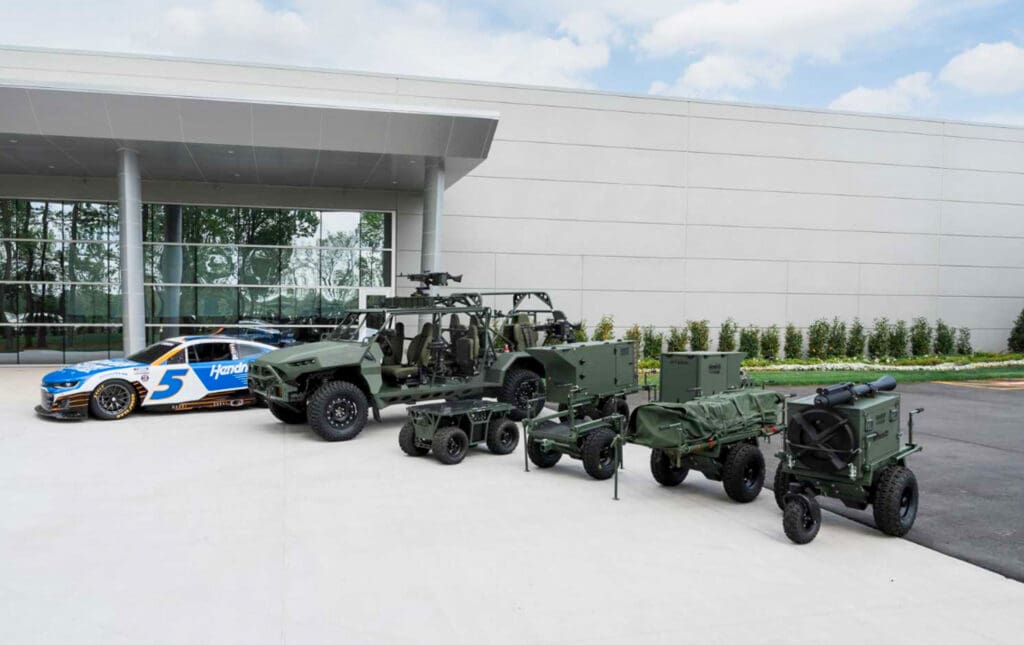
The capabilities built to make race cars lighter, stronger, faster, and more reliable have economic value well beyond racing.
That makes motorsports not simply an end market but an innovation platform.
The Power of Clustering
The report also reinforces something the North Carolina motorsports industry has understood for decades: proximity matters.
Suppliers locate near teams. Specialized workers move where the jobs are. Engineering expertise attracts more engineering expertise. Customers attract suppliers, suppliers attract talent, and talent attracts new companies.
The report cites American Racing Headers’ decision to locate a manufacturing operation in Stanly County as one example. The company’s desire to operate in the heart of racing country resulted in a $4.37 million manufacturing investment and more than 60 jobs.
That is textbook industry clustering.
But North Carolina didn’t create this cluster through a single recruitment campaign. It accumulated over generations through teams, tracks, manufacturers, entrepreneurs, educational institutions, and thousands of skilled workers.
Today, that concentration represents a competitive advantage that would be extraordinarily difficult for another state to replicate.
Heritage Can Be an Economic Asset
North Carolina’s motorsports economy also demonstrates that heritage and economic development do not have to exist in separate conversations.
The revitalization of North Wilkesboro Speedway is a powerful example.
After sitting largely dormant for 27 years, the historic facility received $18 million in federal pandemic-recovery funding through the state, supplemented by another $4 million from NASCAR. The report says the returning 2023 NASCAR All-Star Race subsequently generated an estimated $42.4 million in statewide economic impact, $27.9 million in labor income, and more than 600 jobs, while attracting fans from all 50 states and beyond.
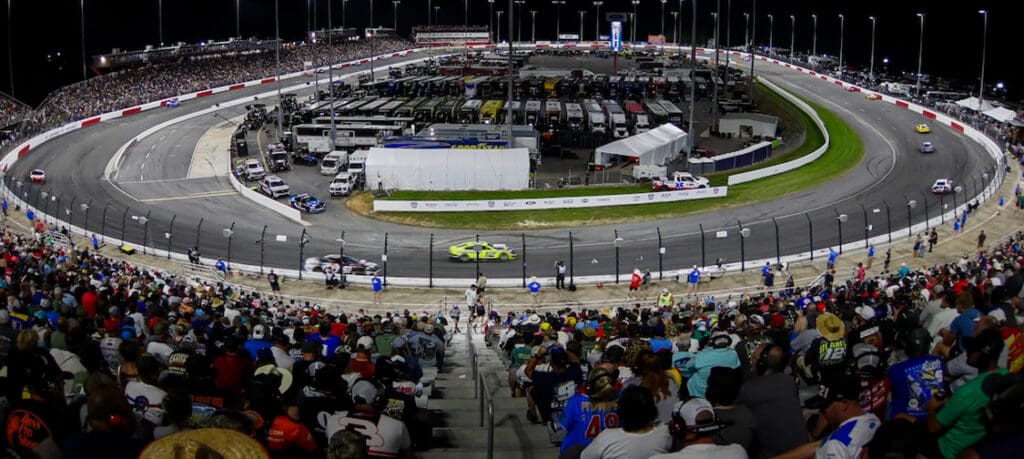
North Wilkesboro illustrates a larger theme running throughout the report: infrastructure matters.
A speedway, stadium, golf course, soccer complex, or trail system is not valuable simply because it exists. Its economic value comes from what happens around it: events, visitors, businesses, transportation, workforce, investment, and recurring activity.
North Carolina motorsports has been converting those assets into economic activity for decades.
Other Sports Are Beginning to Follow a Familiar Path
This is where the report becomes particularly interesting when viewed through a motorsports lens.
Pinehurst is no longer simply somewhere major golf tournaments are played. The USGA has established a permanent presence there, connecting events with administration, research, workforce development, and destination economics.
The Triangle’s sports economy increasingly combines professional franchises, purpose-built facilities, youth participation, and a recurring pipeline of NCAA and amateur events.
Charlotte combines professional franchises, major-event infrastructure, and visitor assets with one of the world’s most developed motorsports economies.
Across these examples, the pattern is familiar: a sport creates the greatest long-term economic value when it builds an ecosystem around itself.
Events create attention and visitor spending. Permanent organizations create jobs. Educational programs create talent. Suppliers create businesses. Infrastructure creates capacity. Research and technology create innovation. Together, these elements make a region more attractive for additional investment.
Motorsports is simply further down that road than most.
A Model for North Carolina’s Broader Sports Economy
The report examines how other states are approaching sports strategically. Virginia has emphasized sports tourism. Texas treats major-event recruitment much like traditional economic development. Indiana has expanded its strategy to encompass sports technology, research, and workforce development.
North Carolina already contains pieces of all those models.
The opportunity the report identifies isn’t necessarily to create another centralized sports bureaucracy. Rather, it is to better recognize and connect assets that already exist across tourism, economic development, universities, local governments, sports organizations, and private industry.
As the report puts it, technical capabilities developed around one sport can migrate into entirely different industries. North Carolina’s opportunity therefore begins not with inventing a sports economy, but with understanding the one it already has and finding ways for its existing strengths to work together.
Motorsports provides the proof of concept.
For generations, racing has connected competition with manufacturing, engineering, entrepreneurship, tourism, technology, workforce development, and North Carolina’s identity.
What began at racetracks became race shops. Race shops attracted suppliers. Suppliers helped build a specialized workforce. That workforce developed technologies and manufacturing capabilities that now reach into industries such as aerospace and defense.
That’s an economic cluster.
North Carolina Is Already in the Sports Business
Perhaps the most important conclusion in the entire report is also one of its simplest:
North Carolina does not need to create a sports economy. It already has one.
The question is how deliberately the state chooses to treat it as an economic competitiveness asset.
For motorsports, that means continuing to think beyond races and racetracks. It means recognizing suppliers as economic-development prospects, motorsports technology as advanced manufacturing, specialized racing talent as workforce infrastructure, historic venues as economic assets, and the industry’s global reputation as a powerful business-recruitment tool.
The NC Chamber Foundation report describes North Carolina as possessing an unusual combination of asset concentration and geographic distribution, with concentrated industry clusters alongside sports activity extending into communities across the state.
Motorsports embodies both.
Motorsports connects North Carolina’s heritage with its economic future through the extraordinary concentration of teams, suppliers, and technology companies in Charlotte, Concord, and Mooresville, as well as the tracks and businesses in North Wilkesboro, Rockingham, Winston-Salem, Hickory, and throughout the state.
For the broader sports economy, there may be no better example of what is possible.
In North Carolina, motorsports isn’t simply part of the sports economy. It shows what the sports economy can become.